
You have no items in your Enquiry List.

The right event giveaway fits the audience, the conversation and the way it will be handed out. A conference delegate pack, a busy exhibition booth and a retail roadshow each need a different merchandise plan.
For Singapore marketing and event teams, start with the people you want to reach and the action you want to support. Then shortlist products, allocate quantities and confirm the complete delivered cost. This guide helps you prepare a useful brief for GiftMart.
Decide what happens before and after the handover. Is the item part of registration, a thank-you after a demonstration, or a meeting gift? A giveaway can support that interaction, but the item alone does not make the recipient a qualified prospect.
| Audience or format | Merchandise role | Planning priority |
|---|---|---|
| General booth visitors | A simple, portable item supporting an introduction | Fast handover, clear branding and a controlled daily allocation |
| Relevant prospects after a discussion | A useful thank-you connected to a demonstration or meeting | Audience fit, agreed eligibility and a useful next step |
| Registered conference delegates | A consistent pack for the event programme | Confirmed registrations, bag fit and efficient collection |
| Roadshow or launch visitors | An item that fits the campaign message and setting | Carrying comfort, location splits and campaign dates |
| Event crew | Identification or working supplies | Separate quantities so operational stock is not handed out |
For different gift tiers, write a simple handover rule that booth staff can apply consistently. Keep the introduction and qualification conversation useful; a full bag of merchandise is not evidence of purchase interest.
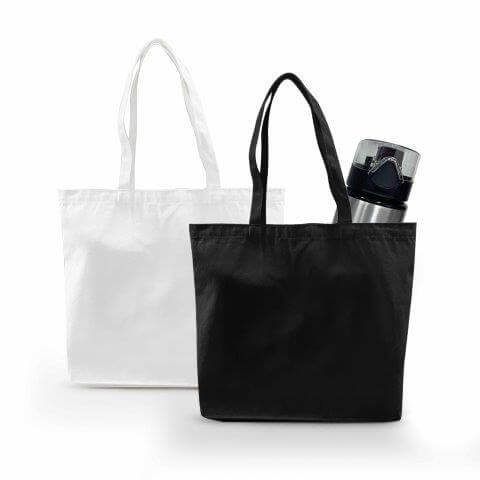
Explore promotional tote bags when recipients need to carry brochures, samples or several items. Check the filled bag, not just its empty dimensions: the opening, base, handles and weight all affect the handover.
The Cotton Canvas Tote 10oz listing gives a size of 47 × 37 × 10 cm and cream or black colour options. Use this as a starting point, then confirm current stock, logo space and how your actual contents fit. Material names alone do not establish recycled content or environmental impact.
Compare promotional jute tote bags and non-woven campaign bags against the actual contents and handover plan. For a conference pack, test the folder and gifts together. For a roadshow, check how easily staff can fill, store and hand out each bag.
With jute designs, confirm the lining or lamination, usable base depth and how fine artwork will reproduce on the chosen print surface. With non-woven designs, confirm the actual material, fabric weight, handle attachment and seams. Fabric weight alone does not establish carrying capacity: assess a sample with the planned load.
Compare like-for-like quotations for bag size, quantities, printed sides, artwork, packing and delivery before your pack-assembly date. Ask about minimum quantities for each colour and whether bags arrive flat or packed as sets. Do not assume a material name or an “eco” product name proves recyclability, recycled content or a lower environmental impact.
For a fuller material and construction comparison, see AbrandZ’s corporate tote and canvas bag buying guide. For your event order, send GiftMart the contents, quantity, artwork, budget and receiving date.
Promotional lanyards can support delegate or crew identification. Specify the badge dimensions and orientation, attachment type, print requirements and any required breakaway feature. Confirm whether badge holders and printed inserts are included; a lanyard-only quote is not a complete credential pack.
For the complete credential specification, use our custom lanyard and badge-fit buying guide.
For roadshows and other settings where a fan is useful, compare the portable fan collection. Check carrying comfort, charging, packed size and runtime at the intended speed. Our branded portable fan buying guide covers these model-specific decisions.
Browse promotional gifts for compact options that fit your message and audience. Compare usable branding space, packing, practicality and suitability for the intended recipients. The lowest unit price is less useful if the item is awkward to distribute or irrelevant to the campaign.
Custom stress balls are one option to compare for a compact event giveaway. Choose a stock shape that relates to the campaign—such as a house, vehicle or simple ball—then check the usable print area rather than assuming the entire surface can carry artwork.
Use the item to support a clear campaign action, such as a product demonstration or follow-up enquiry. Assess success through relevant conversations and resulting enquiries; do not assume a giveaway produces sales or make unsupported wellbeing claims.
Outfitting your crew or participants? See our company-event T-shirt ordering guide for fabric selection, print requirements, size collection and delivery planning.
Use planned handouts rather than the organiser’s total attendance figure. Not every attendee visits your booth, and not every visitor needs the same item.
Order quantity = planned handouts + separately reserved units + approved contingency.
For example, 120 general handouts on each of two days, 30 separate meeting gifts and 15 reserve units means 285 items across the chosen categories. This is a planning example, not a forecast of event traffic. If meeting recipients also receive a general giveaway, include those extra general units explicitly.
Use previous event handout records where available. For a first campaign, state the assumptions and ask about minimum quantities and reorder feasibility before committing.
Ask for an itemised quotation covering products, logo setup, printing positions, packaging, assembly if required, delivery and applicable GST. State whether your budget is per piece, per pack or for the whole campaign.
Compare the same specification across options. A bag alone, a bag with a one-colour logo and a packed delegate kit are different scopes. If the budget is tight, reduce unnecessary components or simplify the artwork before adding more low-value items.
Track both cost per distributed pack and cost per qualified lead. Leftover stock increases the effective cost of the items actually handed out. A larger order may reduce the quoted unit price while increasing total spend and unused inventory.
Give GiftMart the event date and the earlier date when you need the goods in hand. Work backwards through product selection, stock confirmation, quotation approval, any sample review, artwork approval, production, packing and delivery.
Provide logo files, colour references and the intended print position. Check the artwork at its actual size. If a QR code is part of the campaign, use a clear destination and test it on the proposed printed surface or insert before production.
Ask for the schedule for the exact products, quantity and branding. Do not assume that items in one order share the same lead time. Agree how changes to artwork, quantity or product choice affect the deadline.
Specify loose items or assembled packs and ask which packing arrangements are available. Confirm quantities per carton, labels, receiving contacts, delivery windows and any venue access requirements. Allow time to count and check the goods before distribution.
Ordering from overseas with a Singapore receiving point? See AbrandZ’s guide for overseas exhibitors for remote ordering and local receiving considerations. For GiftMart product selection and quotations, use the enquiry link below.
Before the event, agree what your sales team considers a qualified lead: for example, a relevant company, a stated need and an agreed follow-up. Record handouts, meaningful conversations, qualified leads, quotation requests and won orders separately.
Use a campaign-specific landing-page link or QR code and a campaign label in your enquiry records. Ask sales to retain that source when an enquiry becomes a quotation or order. A scan or collected contact is not automatically qualified, and attributed revenue does not prove the giveaway alone caused the sale.
Review the merchandise cost alongside qualified leads, quoted value, won revenue and margin where available. Use the result to adjust the audience, gift mix and allocation for the next event—not simply to increase the number of gifts.
Example brief: “We need 250 branded tote bags for a Singapore conference, plus 30 separately allocated meeting gifts. Please quote the bags with our one-colour logo and suggest meeting-gift options within [budget]. We need delivery by [date] to [location]. Please separate printing, packing, delivery and GST, and confirm sample arrangements and availability.”
Planning an exhibition booth? Use our exhibition giveaway allocation guide to match gifts to visitor groups, calculate stock by item and compare budget choices.
Preparing packs for registered attendees? Our delegate-pack planning guide covers core contents, speaker additions, packed samples and venue receiving.
For a product reveal or rebrand, use our product launch merchandise guide to compare gadgets and practical giveaways, control artwork and plan distribution.
Start with the recipient’s needs: tote bags for carrying materials, lanyards for credentials, or a portable fan for a suitable activity. Choose the exact item by audience, branding, budget and distribution plan rather than a generic popularity list.
A consistent item suits registered delegate packs. Exhibition teams may prefer separate allocations for general visitors and scheduled meetings. Agree the criteria and quantities before the event so staff can distribute them consistently.
These vary by product, stock and customisation. Send your quantity, artwork requirements and receiving date so GiftMart can confirm a workable option. Do not assume that one collection has a single minimum or turnaround time.
Include the contents, packaging, assembly needs and delivery splits in your request. Ask GiftMart to confirm the available service and itemised charges for that order before planning around it.
Connect the campaign to qualified enquiries, quotations and won business. Track handouts and scans as activity measures, then review sales outcomes separately. Compare campaigns with similar audiences and follow-up processes where possible.
Updated 30 September 2026. Product availability, branding, packing and delivery arrangements are confirmed for each quotation.
 lili Jiang